

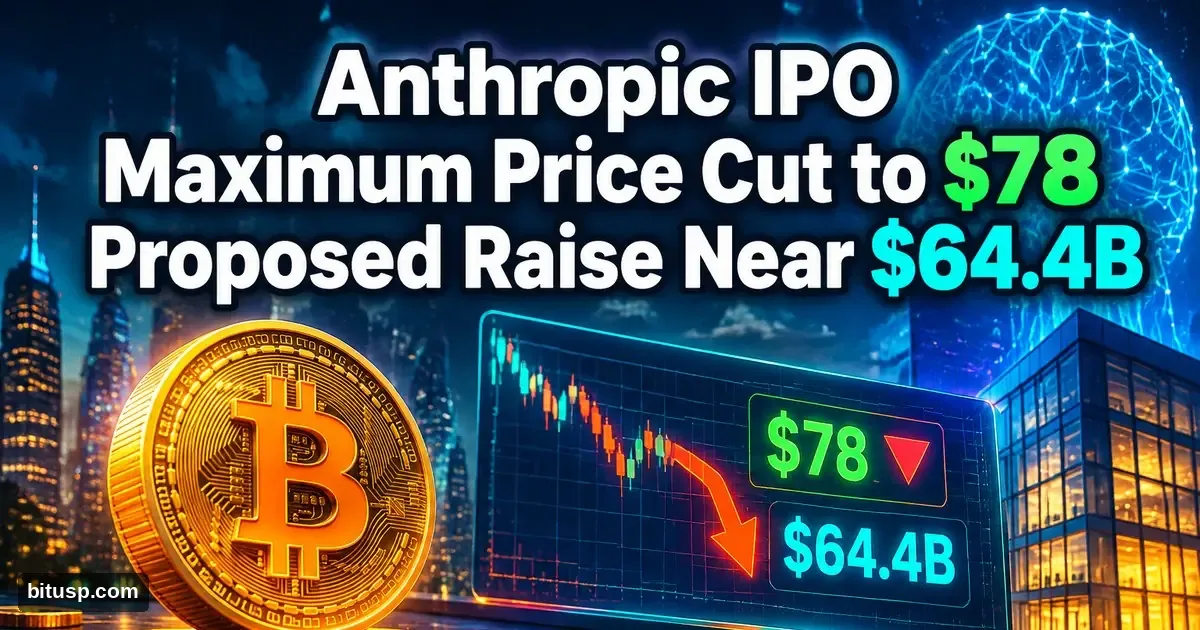

Anthropic has adjusted the draft terms for its upcoming IPO, lowering the proposed maximum share price from $80 to $78 and reducing its potential capital raise from $69.3 billion to approximately $64.4 billion. This update emerged on Tuesday, November 10, following the company’s decision to withdraw an earlier pricing iteration that it deemed inaccurate. The proposed pricing floor remains steady at $70, whereas the reported share count has decreased from roughly 867 million down to 825 million.
These modifications arrive right ahead of the anticipated stock-market launch. Investors are now navigating a massive proposed offering alongside an unexplained adjustment to the IPO guidelines. While Anthropic maintains that the initial information was flawed, management has not specified which elements were incorrect nor provided context for the lowered ceiling.
How the Anthropic IPO Draft Changed
How did the proposed price range shift?
The initial draft circulated among banks outlined a price bracket of $70 to $80 per share. According to BeInCrypto—which cited a revised draft reviewed by Reuters—that range has since been tightened to $70 to $78. The price floor is unchanged, with only the top ceiling shifting downward by $2.

Read More: Anthropic IPO Plans Put AI Valuation Under a Sharper Market Lens
The reported volume of shares also declined from approximately 867 million to 825 million. Multiplying these share volumes by their respective maximum prices yields potential proceeds of $69.3 billion and roughly $64.4 billion. Consequently, the updated ceiling reflects a drop of about $4.9 billion, or roughly a 7% reduction.
Why do the reported share counts differ?
The revised draft indicates a share count of 825 million. Meanwhile, a separate registration document accounts for 948.75 million shares—a figure that incorporates an underwriter option, as noted by The Defiant. Priced at $78 per share, 948.75 million shares would total $74.0 billion, whereas the 825 million share count generates a lower valuation of $64.35 billion.
Why self-custody matters: keep your crypto keys under your own control
A plain-English guide to hardware wallets, seed phrases and backups — from a fictional sponsor.
 LedgerVault
Sponsored
One figure stems directly from the revised draft, while the other factors in the underwriter option. The calculation of $64.35 billion derived from 825 million shares at $78 matches closely with the roughly $64.4 billion maximum headline figure, though the two metrics describe distinct components of the transaction.
Who Is Behind the Offering—and Who Plans to Buy
What is Anthropic?
Anthropic is the creator of Claude, an artificial intelligence chatbot. The firm was established in 2021 by former leaders of OpenAI, as reported by Al Jazeera following the company’s confidential U.S. filing in June.
That confidential submission initiated the public-market journey without disclosing the scale or financial terms of the offering. The pricing specifics currently making the rounds arrive at a later phase, establishing a provisional price range and share count rather than a definitive final share price.
Which technology companies are tied to the deal?
Google, Nvidia, AMD, Broadcom, Micron, Microsoft, and TSMC have committed to purchasing a cumulative $26 billion worth of Anthropic stock at the ultimate IPO price via a private placement. This participation binds several major tech giants to the offering, though it does not dictate the price other public investors will pay.
The private-placement allocation stands as a reported commitment independent of the public share-price interval. Because each participating enterprise will acquire shares at the rate determined by the public offering, the final IPO price carries substantial weight for the private placement as well.
How Anthropic Got From a Confidential Filing to IPO Pricing
What happened before the revised terms?
Anthropic filed confidentially for a U.S. public offering on June 1, 2026. By withholding the offering’s scale and terms, the company was able to advance its preparations while keeping sensitive financial figures out of the public registration.
By November, details distributed to financial institutions pointed to roughly 867 million shares valued between $70 and $80. Per CoinDesk, Anthropic subsequently retracted these metrics, labeling them inaccurate, and promised an updated filing without specifying which particular figures were erroneous.
What led to the correction?
BeInCrypto noted that Anthropic’s external legal counsel in Canada informed banks that the prior documentation contained mistakes. Anthropic refrained from elaborating on the nature of the mistake or commenting on the downsized maximum.
By pulling the initial pricing figures and issuing a replacement set of conditions, Anthropic has left the lower ceiling and reduced share count unexplained. These modifications alone do not clarify whether market demand softened or if the previous numbers simply required administrative correction.
Why the $64.4 Billion Proposal Matters
A large public test for AI-company demand
At the updated maximum, the target raise sits at approximately $64.4 billion, down from as high as $69.3 billion. Even with this decrease, the projected sale remains massive enough to position Anthropic’s final pricing as a critical barometer of public market appetite for major AI enterprises.
With seven technology corporations securing plans to purchase $26 billion in stock, and given that these entities must execute their purchases at the public IPO price, the ultimate valuation holds significant implications for both the private arrangement and the broader market debut.
Why the offering draws attention beyond Anthropic
Jim Cramer, anchor of CNBC’s *Mad Money*, characterized the IPO as “the most consequential deal of our time.” He argued that the transaction matters immensely for tech firms pouring massive capital into AI infrastructure, since their investments rely heavily on the assumption that artificial intelligence ventures can generate positive returns.
This perspective represents Cramer’s commentary rather than a definitive market consensus. Immediate benchmarks remain more straightforward: the final price, the volume of shares put on the market, and whether the public rollout adheres to the anticipated timeline. A reduced maximum cap does not, by itself, indicate the robustness of demand at the ultimate pricing level.
What Could Change Before the IPO
The reason for the lower ceiling is still unresolved
The updated draft outlines a reduced maximum price and a smaller share count compared to the retracted iteration, yet offers no rationale for the shift. Media reports have floated possibilities ranging from cooling investor demand to simple administrative corrections, but neither scenario has been officially validated.
Anthropic’s declaration that the initial pricing data was flawed omitted any specific breakdown of the mistakes. Until terms are locked in, investors should treat the $70–$78 band as a provisional proposal rather than a guaranteed transaction price.
Proposed purchases are not the final public price
The reported $26 billion commitment from the seven tech firms is contingent upon the official IPO price. Consequently, the final valuation will remain a vital focal point, though the prior commitments neither dictate the ultimate price nor guarantee that the offering will conclude on a specific schedule.
While the proposed bracket, share volume, and capital-raising targets will influence how the market receives the listing, they remain draft terms. The ultimate public-market outcome hinges on final specifications and whether the process successfully hits its intended window.
When Is Anthropic’s Listing Expected?
What timing has been reported?
In relation to the November 10 report, the market debut was anticipated to take place on a Thursday or Friday of the following week. This schedule remained a projection rather than a confirmed commencement date for trading.
Because the final IPO price dictates the valuation applied to private-placement participants, investors are advised to monitor for finalized pricing and terms rather than assuming Anthropic will trade at the revised ceiling.
Anthropic’s Fundraising and the Competitive IPO Race
Anthropic’s confidential June registration followed a late-May funding cycle where the firm secured $65 billion at a valuation of $965 billion. At that juncture, Anthropic reported that annualized revenue had hit $47 billion, propelled by Claude sales across consumer and organizational segments. These metrics highlight the company’s sheer scale and the magnitude of its proposed IPO, though they do not guarantee future revenue generation or dictate the offering’s final valuation.
Furthermore, the company enters a crowded landscape of public market aspirants. OpenAI has been prepping its own confidential U.S. IPO filing, while SpaceX has targeted a $75 billion raise at a $1.75 trillion valuation. Such prospective blockbusters could vie for investor attention and liquidity. Analysts note that multiple mega-offerings of this magnitude risk disrupting capital markets or diverting funds away from smaller IPOs, placing Anthropic’s revised terms within a broader competitive arena.
Anthropic and OpenAI have targeted distinct customer bases, with Anthropic leaning into enterprise clients, software development, and coding tools, while OpenAI centers more heavily on consumer applications. These distinct strategies have fueled investor debates regarding growth outlooks, though public market participants will ultimately evaluate each enterprise based on disclosed financials and final offering metrics. Anthropic’s debut may also influence how Wall Street appraises other AI firms pursuing public listings.
Market Attention Has Extended Beyond the IPO Filing
Cramer’s remarks coincided with a separate news cycle surrounding Nvidia. He expressed frustration that relentless media coverage regarding “Jensen”—referring to Nvidia CEO Jensen Huang—was overshadowing Anthropic’s offering. Nvidia shares declined more than 4% on Monday following revelations that the company’s board was investigating whether Huang had been targeted by Chinese intelligence after he acknowledged an affair. Although this Nvidia development was separate from Anthropic’s pricing adjustment, it demonstrated how news regarding a major IPO can be sidelined by events impacting the hardware providers that finance the AI ecosystem.
Cramer also underscored that chip manufacturers and data center developers are deploying billions on the presumption that AI software providers will earn enough to justify the infrastructure buildout. “Without it, I don’t see how the AI-related stocks can make a real recovery,” he stated. While his commentary frames the IPO as a litmus test for the wider AI sector, it does not imply that Anthropic’s altered pricing has inherently altered demand for AI-related equities.
Conversely, other market participants maintain that appetite for AI-company shares can weather adverse headlines. Dan Ives, a senior managing director at Yorkville Ives, told Yahoo Finance, “I think appetite is going to be strong,” while acknowledging that negative news can unnerve investors. This counter-perspective leaves open the question of how much demand Anthropic will ultimately command at its final IPO price.
FAQ
01What share price range does Anthropic’s revised IPO draft propose?
The revised draft establishes a reported range of $70 to $78 per share. The lower boundary is identical to the previous $70–$80 version, while the maximum price is lowered by $2.
02Why did Anthropic withdraw the earlier pricing details?
Anthropic stated that the previously distributed pricing figures were incorrect and committed to providing an updated filing. The company did not clarify which specific metrics were inaccurate or explain the shift in the maximum proposed raise.
03Which companies reportedly plan to buy shares?
Google, Nvidia, AMD, Broadcom, Micron, Microsoft, and TSMC were identified as participants in a joint $26 billion private placement, with plans to purchase shares at the established IPO price.
04What does the $78 figure represent in Anthropic’s revised IPO draft?
It marks the revised draft’s proposed maximum share price rather than a finalized cost. The reported pricing structure begins at a $70 floor, and the final IPO price will dictate the acquisition cost for the private-placement participants.
05What is the difference between 825 million and 948.75 million shares?
The 825 million figure represents the share count cited in the revised draft, whereas the 948.75 million figure incorporates an underwriter option, meaning the two totals reflect different presentations of the offering.
Why did the proposed offering amount fall?
The reduction stems from the maximum share price dropping from $80 to $78 combined with a decrease in the reported share count from approximately 867 million to 825 million, collectively lowering the target raise by about $4.9 billion to roughly $64.4 billion.
06When is the stock-market debut expected?
The listing was projected for a Thursday or Friday during the week following November 10, though this schedule was framed as an expectation rather than a confirmed trading date.
This article is for information only and is not financial advice.