
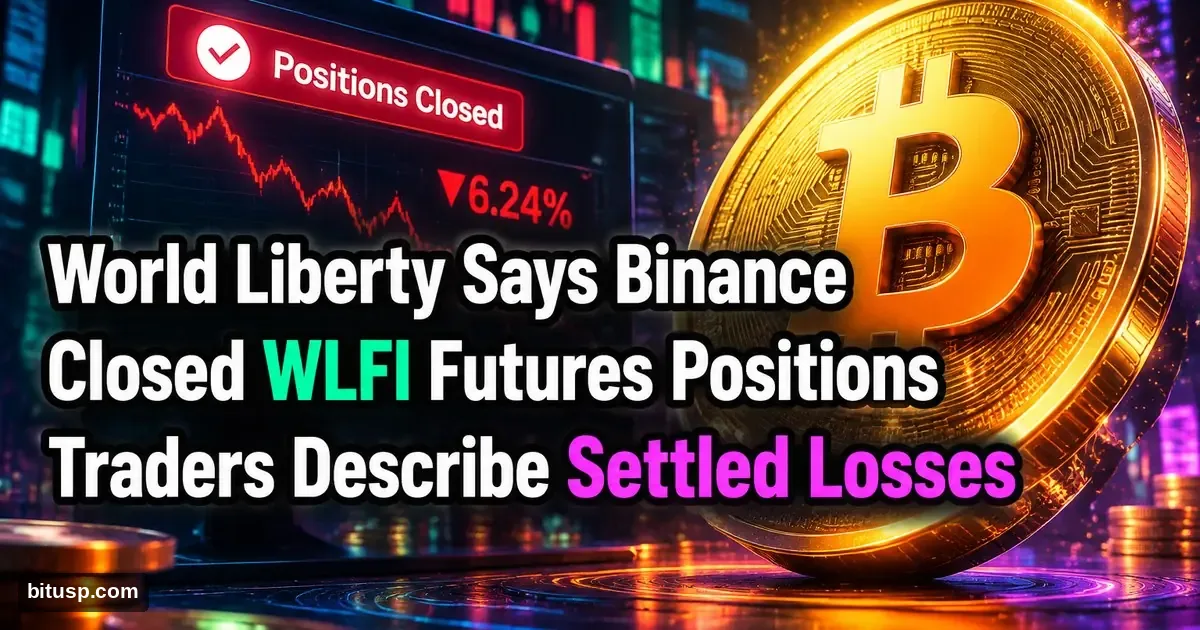

World Liberty Financial reported that Binance closed WLFI futures positions, according to details published by The Defiant on November 28, 2026.
This grievance adds an exchange-execution issue to a tumultuous period for the Trump-supported venture. During the same timeframe, its governance token plummeted to an all-time low, a treasury-connected wallet disposed of ether, and early investor Justin Sun urged trading platforms and regulatory authorities to take action against both WLFI and the project’s USD1 stablecoin.
World Liberty Raises a Complaint About Binance WLFI Futures
What Did World Liberty Say About Traders’ Positions?
According to World Liberty, certain traders observed profits on their WLFI futures positions right before closure, only to have them settle at a loss. Binance has not issued public clarification regarding how it calculated the exit prices.
Read More: World Liberty Financial Countersues Justin Sun Over WLFI
The dispute centers on the gap between the pre-closure profits visible to traders and the losses logged upon settlement. The available information does not disclose the identities of the impacted traders, specify the exact quantum of their losses, or supply individual execution prices, leaving the scale of the alleged discrepancy unverified.
When Did the Complaint Become Public?
The Defiant released its report at 12:50 UTC on November 28, following earlier coverage detailing the WLFI sell-off and a substantial ETH transfer tied to the enterprise.
The day’s news unfolded incrementally: the treasury transaction and token crash were initially covered at 09:32 UTC, succeeded by an overarching market summary at 12:00 UTC. The futures grievance surfaced subsequently, introducing a distinct controversy regarding exchange execution alongside existing anxieties surrounding the project’s token valuation and treasury assets.
World Liberty’s WLFI Token and USD1 Face Scrutiny
Which World Liberty Products Are Involved?
World Liberty runs a decentralized lending and stablecoin ecosystem. It issues the governance asset WLFI alongside USD1, a stablecoin engineered to maintain a one-to-one parity with the US dollar.
Who Is Behind World Liberty Financial?
The enterprise debuted in the lead-up to the 2024 presidential election. Donald Trump, alongside his sons Eric Trump, Donald Trump Jr., and Barron Trump, co-established and championed the platform alongside operational leaders like Zach Witkoff and Chase Herro.
Tron blockchain creator Justin Sun emerged as one of the venture’s premier early backers.
A Treasury-Linked ETH Sale During the WLFI Sell-Off
What Did Trackers Identify in the ETH Transaction?
Data from blockchain analysts EmberCN and Arkham Intelligence, highlighted by CoinDesk, revealed that a wallet designated as “World Liberty Financial: Strategic Reserve” liquidated 12,121 ETH via CoW Swap for $20.06 million worth of stablecoins.
The acquired funds comprised $17.58 million in USDC and $2.48 million in USD1.
The wallet activity was flagged early on November 28 amidst the steep descent of WLFI. Although inquiries were submitted to World Liberty concerning both the token depreciation and the wallet transfers prior to the 09:32 UTC publication, no official response had been provided. While the transaction itself was verifiable onchain, the initiative’s rationale for executing the transfer remained undisclosed at the time.
How Did the Sale Compare With the ETH Purchase Cost?
Analytics estimates placed the average disposal price at roughly $1,655 per ETH, contrasting with an estimated acquisition cost of about $3,244 per ETH incurred during the prior year. Based on these averages, the ether was unloaded at an approximate 49% discount relative to purchase price, yielding an estimated realized loss of $19.26 million.
WLFI Reaches a Record Low as Attention Turns to Borrowing
What Happened to WLFI During the Sell-Off?
Metrics from CoinGecko indicated that WLFI dropped below $0.017 to hit a record low during the market downturn. The cryptocurrency later experienced a brief recovery before encountering renewed downward pressure, as captured in ongoing evaluations of WLFI’s erratic trading activity.
Subsequent market commentary noted a contraction exceeding 55%. Following initial stability in the wake of reports concerning the $20 million ETH liquidation, WLFI experienced a sharp drop. An attempted rebound stalled when sellers rejected the price at $0.20, leaving the recovery vulnerable.
Related: USD1 Slips Below $1 on Three Exchanges After WLFI Selloff
An earlier valuation gauge registered the bottom near $0.016 with a recovery plateau near $0.020. Measured against its September 2025 peak of $0.33, WLFI experienced an approximate 95% drawdown, reflecting rapid intraday movements through fresh troughs and failed recovery attempts.
<
Why Is World Liberty’s Dolomite Loan Part of the Discussion?
Earlier in 2026, World Liberty secured a $75 million stablecoin loan on Dolomite backed by approximately 5 billion WLFI tokens. Observers on X hypothesized that the ether liquidation might be directed toward servicing the debt or bolstering collateral reserves.
Additional conjecture centered on whether the move aimed to adjust the loan’s liquidation parameters. However, the identified wallet transfer did not independently confirm these intended uses, and available reports lacked any official confirmation linking the ETH conversion to debt settlement or collateral adjustments.
The WLFI Crash Followed a Volatile Week for Bitcoin
The token’s depreciation occurred alongside bitcoin slipping beneath the $60,000 threshold. After facing rejection at $62,000 on Friday and following the reopening of US markets post-holiday, bitcoin retreated to just under $59,000. An initial recovery attempt stalled at $60,000, leaving the cryptocurrency struggling to defend the $59,000 mark during midday evaluations.
The preceding Saturday recorded a deeper trough at $55,000—bitcoin’s weakest valuation since September 2024. This followed a $26,000 decline over a span of less than three weeks, during which bitcoin broke down through $80,000, $70,000, and $60,000. A subsequent rebound lifted the asset to $57,000 within hours and $60,000 by Sunday.
Monday brought another retreat to $59,000 followed by a climb to $61,000, prior to reports regarding Nvidia and Jensen Huang helping propel bitcoin to $64,500. This upward momentum proved temporary; a high Personal Consumption Expenditures (PCE) inflation reading on Wednesday dragged bitcoin down to $57,100 ahead of a recovery that preceded Friday’s failed test of $62,000.
Ether also experienced downward pressure alongside World Liberty’s liquidation, shedding 5% to trade under $1,650 in market reports, while HYPE posted similar losses below $63. Digital assets including XLM, AVAX, ADA, QNT, RAIN, PEPE, and ENA registered declines of up to 7%, contextualizing WLFI’s far steeper drop within a broader macro-negative session.
Market exceptions included BTW, which advanced more than 55% toward $1.60. Across the broader sector, total cryptocurrency capitalization dropped over 3.5% within a 24-hour window, lingering below $2.050 trillion, with bitcoin commanding 58.4% market dominance.
A separate CoinGecko snapshot taken at 13:01 UTC on November 28 pegged bitcoin at $59,197, marking a 24-hour loss of roughly 3.85%. Its valuation stood near $1.191 trillion alongside approximately $24.69 billion in aggregate trading volume over the same duration, keeping the asset beneath the $60,000 mark.
Justin Sun’s Frozen WLFI Holdings Precede the Latest Clash
How Did Sun’s Investment Become a Dispute?
Sun committed $30 million to World Liberty starting in late 2024. Shortly after trading commenced in September 2025, his wallet address was blacklisted, freezing roughly 595 million unlocked tokens valued at approximately $107 million at the time.
What Do the Competing Lawsuits Allege?
Sun initiated federal legal proceedings against World Liberty in April 2026, citing allegations of fraud and extortion. In response, World Liberty filed a countersuit in May accusing him of actively shorting WLFI to depress its market valuation.
WLFI Faces Execution, Treasury and Legal Risks
What Is at Stake for Futures Traders and Token Holders?
For impacted futures participants, the core issue revolves around Binance’s execution pricing methodology. For token holders, the ongoing dispute with Sun complicates questions of asset liquidity, while the recent ETH sale draws critical scrutiny toward the project’s asset management strategies.
What Has Sun Accused World Liberty of Doing?
Sun’s allegations encompassed insider liquidations, unauthorized freezing of investor allocations, and systemic fraud. He further claimed that associated representatives purged social media posts and internal communications.
“Today’s WLFI episode is just another rerun of insider circular lending to cash out,” Sun posted on X, characterizing the activity as unauthorized insider distribution. His commentary linked the latest valuation collapse to broader grievances regarding investor treatment and project asset allocation.
Sun categorized the deletion of communications as “mass-deleting” intended to obscure misconduct. These assertions originated from an investor currently embroiled in active litigation with World Liberty and have not been validated as formal determinations by any court or regulatory body.
What to Watch After Sun’s Call for Action on WLFI and USD1
Which Measures Is Sun Asking Exchanges to Take?
Sun advocated for the implementation of warning advisories, prompt delisting procedures, deposit restrictions, and full transparency regarding the destination of dispersed funds. His appeal targeted both WLFI and USD1, calling for intervention from trading platforms, regulatory bodies, judicial institutions, and courts.
“I call on major exchanges, regulators, judicial authorities, and the courts to take prompt action against WLFI and USD1,” Sun stated, concluding his remarks on deleted communications with the warning that “action cannot wait.” The appeal demanded coordinated intervention across financial and legal venues without providing a timeline for execution.
What Would Address Traders’ and Holders’ Concerns?
Official exchange disclosures could shed light on how futures positions were priced and whether deposit or listing statuses will face modification. Similarly, an explicit statement from World Liberty addressing the ETH liquidation could clarify whether the funds were applied toward the Dolomite credit facility.
Current reports confirmed no immediate exchange delistings, new regulatory enforcement actions, or scheduled judicial decisions stemming from Sun’s appeals. His requested restrictions remain pending demands, while clarification from Binance regarding exit pricing and World Liberty regarding treasury management remain outstanding.
USD1 briefly dipped to 94 cents prior to stabilizing near its targeted dollar peg, according to TradingView metrics highlighted by CoinDesk.
FAQ
01Which Trading Service Handled the Sale of 12,121 ETH?
Market monitors identified CoW Swap as the venue utilized for the transaction, executed via a wallet designated as “World Liberty Financial: Strategic Reserve.”
02Which Stablecoins Were Received in the ETH Sale?
The wallet collected $17.58 million in USDC and $2.48 million in USD1, culminating in aggregate proceeds of $20.06 million.
03What Average ETH Sale Price and Realized Loss Did the Trackers Estimate?
Analysts calculated an average liquidation price of approximately $1,655 per ETH, resulting in an estimated realized loss of $19.26 million when compared against an average acquisition cost of roughly $3,244 per ETH from the preceding year.
04How Much Did USD1 Fall Before Returning Close to Its Dollar Peg?
USD1 temporarily traded down to 94 cents during the early hours of November 28, based on TradingView metrics referenced in the coverage, before rebounding toward parity.
05How Many of Justin Sun’s Unlocked WLFI Tokens Were Frozen?
The restriction impacted approximately 595 million unlocked WLFI tokens, which held an estimated value of $107 million following the launch of trading in September 2025.
06When Did Justin Sun and World Liberty File Their Competing Lawsuits?
Sun launched his federal complaint in April 2026 citing fraud and extortion, while World Liberty responded with a countersuit in May alleging deliberate shorting to drive down the token price.
07Which Lending Platform Held World Liberty’s WLFI-Backed Loan?
World Liberty maintained a $75 million stablecoin credit line on Dolomite established earlier in 2026, secured by roughly 5 billion WLFI tokens.
This article is for information only and is not financial advice.

Why self-custody matters: keep your crypto keys under your own control
A plain-English guide to hardware wallets, seed phrases and backups — from a fictional sponsor.
 LedgerVault
Sponsored